A year ago, I was fifteen kilometres into an off-road half marathon in Rotorua when a medical support runner came sprinting up the trail toward me. He looked at me with genuine concern. “Don’t stress, I’m here. Is it a broken ankle?”
From the way I was moving, gingerly clambering down a technical descent like a rusted machine, he genuinely believed I was hurt.
“Nah,” I said. “I’m not hurt. You’d better carry on finding the guy who actually is.”
But I was hurt. Not in the way he meant. I was fifty-seven, carrying ninety-one kilograms on a frame that works best at eighty, and my left knee required nightly painkillers just to find sleep.
I was a Professor of Public Health and Chief Science Officer at PREKURE, an organisation built on the premise that prevention is cure. My entire career was devoted to human health, yet I couldn’t hurry across a road if a car was coming.
My wife passed me. My sister-in-law passed me. Near the finish, an overweight older man walked past me at a steady clip. My internal monologue, which accidentally became external, was blunt: The absolute state of this.
The easy way out
A surgeon studied my scans and delivered his verdict: “You won’t run again.” He noted I had developed Chronic Pain Syndrome. I could have accepted that. It was a medically sanctioned exit ramp, an easy way out.
Then Cyclone Alfred stranded me on the tenth floor of an apartment on the Gold Coast. Power out, elevators dead. No gym, no physio, no ideal rehab programme. Just a dark internal staircase. With nothing else to do, I started climbing. Then running. The repetitive loading was resetting pathways that months of cautious management had failed to touch. Nothing like a natural disaster to create the conditions for rehabilitation.
Back in New Zealand, I entered a half Ironman, dropped to eighty-eight kilograms, and ran twenty-one kilometres with zero knee pain. Then my sister-in-law Clara, mother of triplets with no bike and no marathon experience, announced she was entering the full Ironman New Zealand. If she could commit to that, what was my excuse?
I committed. I resigned my professorship to find the training hours. I dropped from ninety-one kilograms to eighty. I entered races, finished third in my age group at the National Long Distance Championships. For the first time in years, I was thriving. All because I had committed to something that terrified me. Now I’m still involved in the university, just in a reduced capacity.
Dad, You’ve Got Eight Kilometres. Start Running.
Race week tried to break me before the race could. My rear bike hub snapped two days out. The two nights before the race, I managed a combined three hours of sleep. On race morning at the edge of Lake Taupo, my resting heart rate was 131 beats per minute.
The swim was a grind. The 180-kilometre bike was a battle. But the real test was the marathon, because the marathon is where the Ironman truly begins. My plan to run nine minutes and walk one held for fourteen kilometres. By twenty, I was only walking. And walking in a running race is a specific type of reckoning. Your mind calculates the remaining distance and arrives at a conclusion you’ve been avoiding: I might not finish.
At thirty-four kilometres, my son Jackson pulled up on a bike. He didn’t offer sympathy. He told me I could run. I told him I couldn’t run. He just started counting…5, 4, 3, 2, 1. I ran. Ten seconds felt like a minute. Then I heard him on the phone to the family, his voice thick with excitement: “He’s running again!”
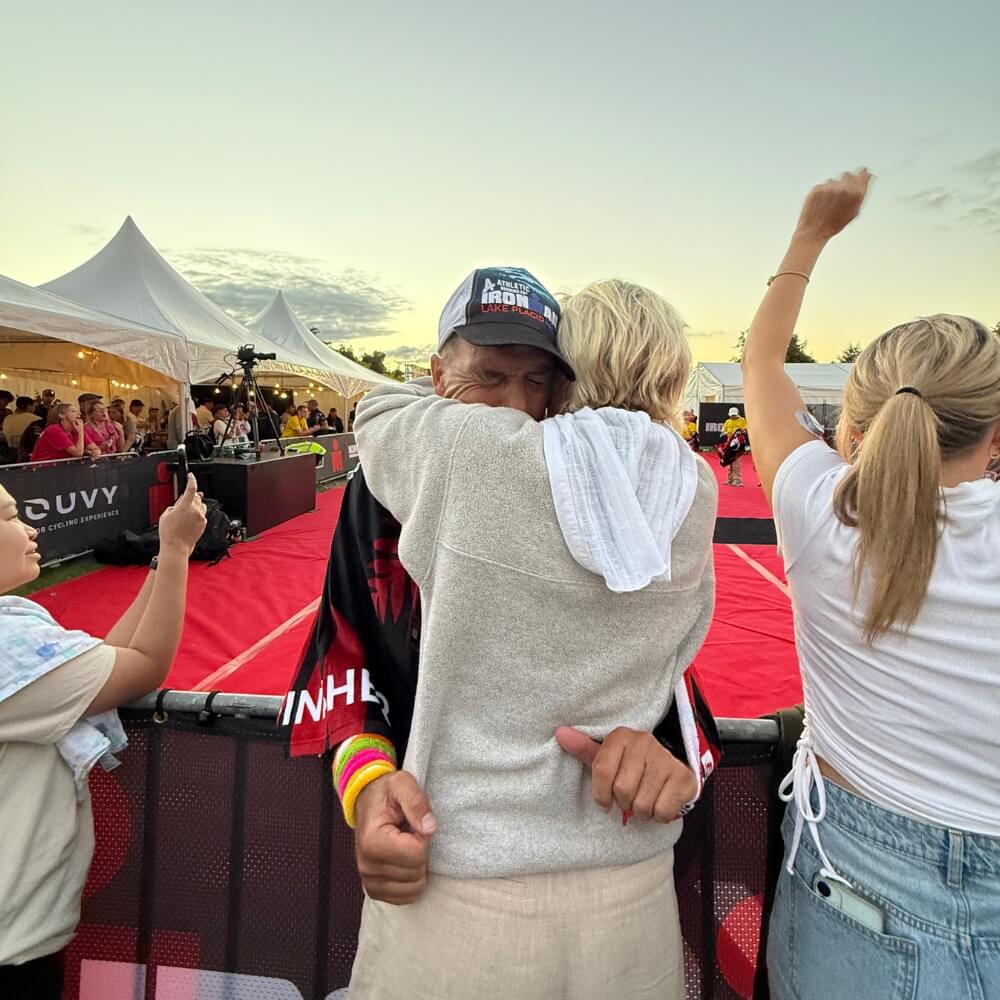
I crossed the line as the light was fading. A year earlier, a surgeon had told me I’d never run again. That evening, I’d completed a marathon after a 180-kilometre bike ride. My knees were the only part of me that didn’t hurt.
You Can’t Show Resilience Until Things Don’t Go Your Way
Afterward, my eldest son Sam saw my slow marathon data on Strava. He didn’t comment on the time. He wrote: “Legend of the game. You can only show true resilience when things don’t go your way.”
That is the essence of it. Resilience isn’t a trait you possess. It’s a muscle you build when the hub breaks, when the sleep doesn’t come, and when your legs quit at thirty kilometres.
You can drift toward comfort, toward managed decline, toward a life defined by what you used to be. Or you can choose your hard. Choose the one that brings you home to your tribe.
Because on the other side of that struggle is the only version of your life worth living.
– Grant


